Now that Oregon’s legislature is nearly split down the middle – 30–30 for Congress and 16-14 for Senate – they’re set to tackle one of the most influential and ignored issues in local politics and representative democracy: redistricting.
See? Even the name sounds exciting. Drawing lines in the sand might not be a hot-button issue like taxes, weed and mandatory minimum sentencing, but it matters. A lot. The average citizen might not care, but it’s so important to politicians that in some states local laws keep it entirely out of their hands, instead being delegated to outside groups who don’t have as much to gain from the outcome. Oregon’s tried to enact similar rules, but it’s fizzled out every time. Either way, it will have a dramatic effect on the political process for the next ten years.
For example, redrawing electoral district lines means an area’s Representative could change, and some incumbents will be trying to appeal to new faces in their bid for re-election. The choices that are made in redrawing the borders will shape who has an easy political battle and which party gains control of the statehouse. When it’s done for a deliberate political advantage, it’s called Gerrymandering, and it’s very illegal.
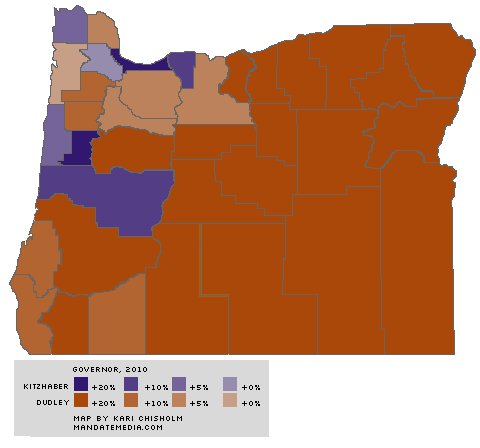
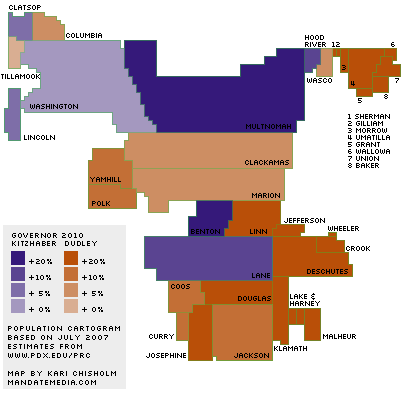
We only need to look back a couple weeks to the gubernatorial race between Governor John Kitzhaber and opponent Chris Dudley to see the importance of county lines. Dudley lost by a single percentage point, with most of it coming from the liberal Multnomah County. (Graphics courtesy of BlueOregon — LOL!)
Ever looked at a sea of red and wondered how it could be a 50/50 split?
Adjusted for population. Now imagine the effect that moving one of those borders in a densely populated area like Multnomah County. This is why it's the stuff of political wet dreams.
Redistricting typically happens after each census, with the new figures being used to redraw district lines to meet a set of criteria in Oregon law. All districts must:
– Be contiguous. (A district can’t be split in to two separate regions that aren’t connected, e.g. Palestine.)
– Be equal in population.
– Respect existing geographic or political boundaries (Sorry, Portland. Vancouver, WA can’t be counted in your district, even if it might as well be a suburb.)
– Must not divide communities of common interest.
– Be connected by transportation links.
The Oregon Congress hasn’t able to agree to district boundaries since 1981. In this case, the duty defaults to the Secretary of State. In 2001 during his first bout as governor, Kitzhaber vetoed the GOP-created boundaries, which meant it was Bill Bradbury’s job to do it. That’s the same Bill Bradbury who ran against Kitzhaber as a Democratic candidate, so some political commentators have said that the borders he drew are responsible for Democratic gains since then.
Congress is expecting the new census data sometime in March, and has until July 1 to turn in their revisions. If they don’t, the duty will fall on the current Secretary of State, Democrat Kate Brown.
Current Oregon legislative districts. Does this turn you on? If so, you might be a politician.
Measure 73, which proposed mandatory minimum sentencing of 25 years in prison for “repeat offenders” of sex crimes, passed yesterday. I won’t get into the drunk driving portion of the bill; suffice to say that throwing people in jail is not perhaps the most effective route, but I’m not as concerned with that half of the bill. The bits that got me worked up were the ones that now have a minimum sentence of 300 months in prison awaiting anybody who commits four or more “sex crimes.” The language on the measure is a little vague, but the fact that it comes about at a time when social trends, particularly the advent of “sexting,” have everybody* scrutinizing relevant laws means that jail sentence could come down in some unfortunate circumstances.
The question here is, what counts as repeat offenses? Under Oregon law, a high school senior who just turned 18 dating a freshman who is about to turn 15 will be guilty of a class C felony if the senior has sexual intercourse with the freshman. The case may be a bit fringe and a bit creepy depending on your views, but these things happen with some frequency. Let us say that these two consummated their relationship more than four times, and the senior gets brought up on multiple charges. If the case can be brought against the senior in this way, that person now faces a minimum of 25 years in prison.
Or, let us look at those darn kids and their “sexting” by playing a game of make-believe. I am now a pretty, 16 year-old high school girl** with a boy in mind who I think is nifty-keen. I decide to send him a few racy text messages, maybe snap a few suggestive camera pictures with my phone and enclose them. Now let us say that I decide to send precisely four or more of these pictures. Cases have already arisen where teens face criminal charges for sexting, and if I as a 16 year-old, theoretical high school girl can be brought up on multiple charges then I would face at least 300 months in jail for sexually abusing myself.
People should not be allowed to go a-rapin’ or produce child pornography, and it would be silly to construe opposition to laws like this as anything of the sort. When mandatory minimums are put into place it strips judges of the freedom to adjust sentences based on circumstances. In a borderline statutory rape case a judge could theoretically swing a lighter punishment based on what actually happened, but if a person is technically convicted 4+ times of some sex crime then they have to be sentenced to a big sack of jail time. Does the state of Oregon really need measures like this to ensure that serial rapists get jail time?
*No, I don’t actually mean everybody.
**When I wear the dress, I’m always a pretty 16 year-old girl.
Posted in Government, Oregon | Comments Off on Mandatory Minimum Measure Passed… Hooray?
Portlanders who came across protesters chanting and carrying signs of green vaguely star-shaped leaves probably thought it was a “Yes on 74” march. Until that is, they read the text: “Keep Your Laws Off My Liquor” and “Free Agave.”
What is mezcal? It’s liquor distilled from the agave plant. All tequila is mezcal – tequila being distilled from the leaves of the blue variety of the agave, in particular – but not all mezcal is tequila. Over the years, stories of a vile-tasting and possible hallucinogenic worm in the bottom of the bottle has given it kind of a bad rap, but some enthusiasts are working to change this perception.
But it’s not that the OLCC is anti-mezcal. They wanted to clear this up for everyone, so they Tweeted and re-Tweeted a notice to people writing about the event that: “OLCC is not blocking Mezcal. You can get several kinds at liquor stores. Go to www.oregonliquorsearch.com.”
Restaurant and bar owners aren’t arguing that there aren’t some 13 varieties of mezcal available on the Oregon market, though. Ilegal is a small-batch distilled in Oaxaca, regarded as one of the most sought-after brands to jump the border, and they’re upset that they can’t get the artisan liquor without a convoluted and costly special order process.
What’s the process consist of? Well, according to the OLCC blog, it’s quite simple, really:
“You can go to any liquor store to place your special order. The store will write up your request, and submit it to the OLCC for processing. Your order is then placed to the distillery. The distiller will ship your order to OLCC’s warehouse, where it will be transferred to the liquor store. The liquor store will notify you when your items arrive. Special orders generally take about six to eight weeks.”
See? Only seven steps in as many weeks. Brought to you by bureaucracy, and the letter “O.”
“We’ve been really frustrated because these artisanal spirits that we’re very excited about have had a hard time getting into the state through the OLCC,” said David Shenaut, President of the Oregon Bartender’s Guild, said to the San Francisco Chronicle. “They go on ‘special order’ at exorbitant prices-they’re very over-priced.”
John Rexer, owner of Ilegal Mezcal, made a statement of support for the march. “This is all in fun, and it is great to see the support for “real” mezcal in Oregon and elsewhere. I can’t thank the bartenders in Portland enough for getting behind Ilegal and the other brands of artisanal Mezcal. It’s a long road from the tiny factories in Oaxaca to Portland, but these lunatics make it all worth the while. They are the guardians of quality over quantity. One way or another, Ilegal and other artisanal brands, will become available.”
Lunatics? Considering this is a city that flaunts its “Keep Portland Weird” stickers, we’ll take it as a compliment.
Posted in Booze, OLCC, Oregon | Comments Off on No Mezcal is Ilegal
If you’re feeling lost this election season, fear not — the Oregon Commentator is here to tell you how to vote. And if you don’t vote like us, well, you’re considerably less cool.
For those not in the know, certified crazy person Art Robinson is seeking to outseat long-time Democrat Peter DeFazio in the race for Oregon’s 4th congressional district representative. The man sells and markets his own home-school system, in order to “Teach your children to teach themselves and to acquire superior knowledge as did many of America’s most outstanding citizens in the days before socialism in education.” He also founded the Oregon Institute of Science and Medicine, an organization known for promoting Robinson’s crazy home-school curriculum, and this:
Several members of the Institute’s staff are also well known for their work on the Petition Project, an undertaking that has obtained the signatures of more than 31,000 American scientists opposed, on scientific grounds, to the hypothesis of “human-caused global warming” and to concomitant proposals for world-wide energy taxation and rationing.
Totally. Nuts.
But according to internal polling, Robinson is not doing all that bad.* According to the Center for Responsive Politics (totally amazing organization, for the record), he has raised $947,640 to DeFazio’s $904,883. (Data as of September 30, 2010.) Not a big leap up, but $43,000 is nothing to scoff at.
Oh, and this doesn’t include television ads attacking Congressman DeFazio, which were bankrolled by the formerly-mysterious Concerned Taxpayers of America. As part of the decision in Citizens United v. Federal Election Commission, the funders of the PAC did not need to reveal themselves — until this last Friday. It was then discovered that the Concerned Taxpayers of America could only technically refer to themselves in the plural — there are only two of them, and Robinson has since revealed that he only kinda sorta knows one of them.
Ultimately, the attack ads likely have nothing to do with getting Robinson elected. The Washington Post article linked to above states that DeFazio has a feeling his congressional decisions on hedge-fund legislation have something to do with it:
“I have been one of the most prominent critics of Wall Street and tried to call them to account,” DeFazio said. “I’ve obviously made some powerful enemies.”
Robert Mercer, one of the two “concerned taxpayers” who has also donated to the Robinson campaign, is the executive of Renaissance Technologies, a Wall Street hedge-fund that has the potential to suffer in the face of harsher hedge-fund legislation.
Basically, it’s a big mess. Special interests on top of special interests, money flying from hand to hand, television ads that have little semblance of truth . . . how do you navigate through the sea of propaganda and controversy?
Friends, you have the World Wide Web at your disposal. Before sending in your ballot, go and read election endorsements (specifically ours, which will be online this Sunday), research the candidates and the ballot measures, and make your own decisions. Your television is going to lie to you every time.
*I was one of the 300 likely voters called for this Art Robinson poll. “If you knew that Peter DeFazio eats babies, would you still vote for him? Push one for yes, two for no, three if you are unsure.” I’m being hyperbolic, but that was basically the name of the game.
I love it when it’s “everyday students” who start railing against the ASUO, and not those who are watching their every move.
As an addendum to Rockne’s post below, here is the video of Amélie’s convocation speech (this is the whole convocation, her speech starts at 12:30). It is, as Rockne professed, embarrassing, and incredibly disrespectful to those who allowed her the microphone in the first place.
There is a certain level of responsibility that goes with the title of ASUO President. When you speak in public, you are speaking on behalf of more than yourself and the little office you work in. You are speaking on behalf of every incidental fee-paying student at the University of Oregon.
This poses a considerable problem when you are charged with making a speech to introduce a batch of around 4,000 brand new students to the University. As ASUO President, you have not made any headway in trying to deduce how students feel about any particular issue — mostly because students are not informed about most things happening on campus. It is for this reason that most convocation speeches (at least in the last few years) by ASUO Presidents have been largely apolitical, for fear of misrepresenting student views and being disrespectful to students in the process.
It becomes much harder when you decide to throw all of your responsibility out the window and flat out lie to those sitting before you. Amélie’s description of the riot on September 25th — that the Eugene Police Department started taking action because of one person throwing one beer bottle at one cop car — is completely absurd. The crowd was asked to disperse because they were blocking traffic and being loud, and when they did not disperse, actions were taken. And then, in a stunning display of putting the cart before the horse, she goes on to talk about arming the Department of Public Safety. What? DPS was nowhere near the incident, as it was not in their jurisdiction, and the proposals for DPS do not include arming them — at least not at the moment.
Her criticisms of President Lariviere’s New Partnership proposal were just as absurd, if not more. I’m not even going to address this one, because you can all read the white paper and see for yourself just how misinformed she is. I wonder if she’s even read it yet.
The worst part about all of this is the 4,000 freshmen who believed every single word she said. I have encountered those people, and no matter how many letters run in the Ol’ Dirty Emerald, there is going to be a large group of people who believe what she says and continue to do so throughout the year.
If any University undergraduates are reading this, please do your part to get informed about issues on campus. Especially when it comes to the ASUO, titles are meaningless. Just because a president says it, doesn’t mean it’s always true.
Then again, just because a managing editor says it, doesn’t mean it’s always true either.
Supwitchugirl is back, with slightly higher production value and (hopefully) slightly less legal trouble. I wonder if that’s going to affect the popularity of their new song / video, “I Love My Ducks (Return Of The Quack).” [Featuring Joey Harrington!]
Posted in Oregon, Sports | Comments Off on Return of the Quack
If you like reading about silly freshmen making a fuss on a Friday night, you can read about it in the Register Guard and the Oregon Daily Emerald. From the RG article:
“The mass of people was admonished to disperse, but ignored commands, continued chanting obscenities, threw bottles and projectiles at officers, broke car windows and tore down street signs,” [Eugene Police Lt. Doug] Mozan said in a statement. “Tear gas was deployed only after the admonishments were ignored and when the crowd began throwing objects at police.”
The end of the Daily Emerald article shows a real victory for students, with President Rousseau making the best statement of her presidency yet:
ASUO President Amelie Rousseau condemned EPD’s response to the event, and said she believes that the use of weapons against students was an uncalled-for escalation of force, and identified it as “crude and disproportionate.” She also said that she believed the incident has affected her views on whether or not DPS should adopt a sworn and armed police force pending the passage of state legislation.
“I think this should make all students and the University administration think twice about bringing this type of intimidation on to campus.” Rousseau said, “This is exactly why we don’t want a police force on our campus.”
Julie Murphy is from Oregon City. She was inspired to become an entrepreneur by one of her favorite television shows. She and her mother traveled up to Portland, to set up shop in a more lucrative location — Alberta Street. As is often the case, Julie was shut down by the authorities and their “heavy handed regulations.”
The authorization in question is a $120 temporary restaurant license. The business in question is a lemonade stand. Julie Murphy is seven years old.
Even before her daughter had finished making the first batch of lemonade, a man walked up to buy a 50-cent cup.
“They wanted to support a little 7-year-old to earn a little extra summer loot,” she said. “People know what’s going on.”
Even so, Julie was careful about making the lemonade, cleaning her hands with hand sanitizer, using a scoop for the bagged ice and keeping everything covered when it wasn’t in use, Fife said.
Everything was going great for Julie and her mom . . . until the authorities showed up.
After 20 minutes, a “lady with a clipboard” came over and asked for their license. When Fife explained they didn’t have one, the woman told them they would need to leave or possibly face a $500 fine.
Surprised, Fife started to pack up. The people staffing the booths next to them encouraged the two to stay, telling them the inspectors had no right to kick them out of the neighborhood gathering. They also suggested that they give away the lemonade and accept donations instead and one of them made an announcement to the crowd to support the lemonade stand.
That’s when business really picked up — and two inspectors came back, Fife said. Julie started crying, while her mother packed up and others confronted the inspectors. “It was a very big scene,” Fife said.
Technically, any lemonade stand — even one on your front lawn — must be licensed under state law, said Eric Pippert, the food-borne illness prevention program manager for the state’s public health division. But county inspectors are unlikely to go after kids selling lemonade on their front lawn unless, he conceded, their front lawn happens to be on Alberta Street during Last Thursday.
If Lemonade Stand taught me anything, it was the basics of capitalism and entrepreneurship. I learned how to build a business from scratch, keep track of inventory and finances, and understand what kept me afloat. I even opened a lemonade stand in my apartment complex in Hong Kong at age eight, to see what all the fuss is about.
While safety concerns are legitimate, this was a responsible seven-year-old with her mother on hand. Laws are laws, and health regulations are realistic, but . . . seriously Oregon?
I leave you with this, from Julie Murphy’s mother:
While Fife said she does see the need for some food safety regulation, she thinks the county went too far in trying to control events as unstructured as Last Thursday.
“As far as Last Thursday is concerned, people know when they are coming there that it’s more or less a free-for-all,” she said. “It’s gotten to the point where they need to be in all of our decisions. They don’t trust us to make good choices on our own.”
ASUO President Amelie Rousseau was published in the Register-Guard this week, along with a UO alum and a grad student, with an opinion on the UO’s proposed riverfront development. As is the general student opinion on the riverfront, they’re not too pleased:
More than two years has passed since the University of Oregon announced plans for the Oregon Research Institute’s office building and parking lot along the banks of the Willamette River, yet construction has not begun. Instead, the university is burning through taxpayer money and public goodwill by defending a development plan approved when Ronald Reagan was president and mullets were fashionable.
Rather than rolling out the bulldozers at one of several viable sites that aren’t shrouded in controversy, the university has chosen to tout the proposed building’s green design features. Instead of addressing the fundamental problem with the site — that construction on the riverfront forecloses on all other options for using this precious public land for generations to come — the university has been tinkering with the placement of its 200 parking spaces.
They go on to appeal to the reader, mentioning taxpayer funding of this project and how there are other locations that might have been more appropriate had the UO gone through an extended public hearing process.
I can only imagine that Rousseau’s name on this letter shows that she is representing students and our thoughts on the riverfront projects. I certainly applaud that. But I also understand the University of Oregon administration’s reluctance to consult with students on larger-scale building projects. In reality, most students are either ignorant or apathetic, or both. This is more evidence of the UO’s inability to engage, but I think it goes both ways. The administration should be consulting with students on their development projects. Whether or not most students would care is another story.
Posted in ASUO, Campus, City, Eugene, Oregon | Comments Off on Opinions on the Riverfront — Amelie Rousseau edition
The DOJ has released their opinion on the OLCC homebrew issue from a couple weeks ago, and if you were looking forward to a beer or wine competition at this year’s state fair, you are sure to be disappointed:
In a legal opinion made public today, the Oregon Department of Justice has concluded that amateur home brewers lose their exemption under state law that they be licensed as a manufacturer when their home brewed alcoholic liquor is consumed outside the home.
The law in question is ORS 471.403(1), which states:
No person shall brew, ferment, distill, blend or rectify any alcoholic liquor unless licensed so to do by the Oregon Liquor Control Commission. However, the Liquor Control Act does not apply to the making or keeping of naturally fermented wines and fruit juices or beer in the home, for home consumption and not for sale.
Due to the DOJ’s lack of transparency, I’m having trouble finding the actual memo. Beernews.org has some more on the story, including some clarification on how the issue came to light. Also see this article from the Oregonian.
The law is vague, and was born out of a post-Prohibition era attempt to regulate the newly-legal booze flow. Legislators and law enforcers wanted to keep a close watch on the consumption of alcohol. They wanted to regulate it harshly. It isn’t that much different than what’s happening now, right? The OLCC wants to manage every drop of hard alcohol in this state, to, as they put it, prevent over-saturation. They claim to have the best interests of Oregonians in mind, all the while raking in $172 million for the state, most of which goes into the general fund. And let’s not forget last year’s Bend OLCC controversy.
A government organization with ultimate power over a popular commodity is dangerous, self-serving and a horrible precedent for the state of Oregon to set. Popular opinion is turning, though, was more and more people have been expressing their opinions. Maybe the revolution is starting. Maybe Oregonians are going to start fighting back, taking what’s been rightfully ours all along.
The Oregon Liquor Control Commission was recently asked whether certain public competitions involving home made alcohol products were in compliance with the law. We provided guidance to the State Fair and other licensees which stated that such competitions were not authorized because they did not fall within the requirements of this statute ORS 471.403 clearly states that the Liquor Control Act (including the requirement for a liquor license) applies except for beer “brewed in the home for home consumption and not for sale”.
In consultation with the Department of Justice, we have received an initial analysis of the statute regulating home brewing (ORS 471.403) which also indicates that the law only allows for consumption of home brews in the home. The home brewers lose their exemption to craft brew without a license when the home brew is consumed outside of the home.
For all you Oregon State Fair-goers, this means no more home brewed creations to tickle your taste buds. From KATU News in Salem:
The irony is the Oregon State Fair has been holding this home brew competition for years under the same law that is now being interpreted to make the competition illegal. And this in a state known for its microbrews. For example, Oregon is the second largest producer of craft beer in the U.S. and Portland alone has more breweries than any other city in the world, according to the Oregon Brewers Guild.
I don’t know what the deal is here. Oregon’s beer culture is one of the largest ways we draw people into this state and provides important stimulus to our depressing financial situation.
The bill being discussed by Senator Wyden would reduce the excise tax on breweries producing fewer than 2 million barrels a year. The tax would be reduced from $7 to $3.50.
Oregon brewing, responsible for $2.3 billion dollars a year, is an industry that Senator Wyden identified as a key player in getting Oregonians back to work.
It’s interesting to see the different priorities coming from different offices in the state, especially as this ruling from the OLCC and the DOJ is a shift in interpretation from the past 22 years of the home brew competition’s existence. I’m curious to see how it plays into this fall’s elections as well, as I’ve been told that Oregon gubernatorial candidate Chris Dudley is all about privatizing liquor distribution in this state. Like Dudley, I have little patience for state agencies that seek to parent said state’s citizens while raking in $172 million a year.
Posted in Booze, OLCC, Oregon | Comments Off on Beer and Fairs
Some things have been going on during the last couple of months.
1. University of Oregon President Richard Lariviere released a white paper outlining his idea for a restructure of University funding and management. The proposal includes a $1.6 billion endowment for the university, a portion of which would be financed by state bonds. The legislature is not pleased, but it certainly hasfolks talking.
2. The UO got grilled hard by the Oregon Senate Business and Transportation Committee about the $227 million arena project, the process for which did not involve an open bidding process, as would most large scale university projects. The committee also tapped into the Bellotti Buyout. The essence of the Willamette Week article linked to above:
“The university does not inspire confidence,” says committee chairman Sen. Rick Metsger (D-Welches). “What you get from this project is either they don’t know what they’re doing or they don’t want the public to know. Neither is good.”
The process for building the arena is actually pretty convoluted and complicated, and many people are displeased with the progress.
3. The State of Oregon has a pretty unsustainable budget, to the tune of $563 million that will come in across the board cuts to all state entities. Including a $4.7 million cut to the University of Oregon.
4. The University Senate confirmed large-scale campus speech policy changes, with the addition of a Freedom of Inquiry Policy and Facilities Use Policy. This is a real victory for administrators, who wanted to deal with the Pacifica Forum issue but not be seen as only promoting certain kinds of speech or, y’know, violating the First Amendment. The new facilities use policy dictates that only university recognized groups — not individuals — can access space for free. “Non-university entities” can still have space, but they have to pay for it. You can read the Register-Guard’s opinion here.
5. The UO created an Office of Public Records to deal with public records requests as Lariviere tries to deal with the aftermath of the Mike Bellotti deal and an athletic program on the fringes of his reach. They’re hiring a public records officer, if you’re looking for a job.
7. Phil Knight’s private company, Phit LLC, wants to construct additional football facilities to the Len Casanova Athletic Center. But they want to do it in a way that sidesteps the public bidding process by having this private company lease the land from the university, construct on it, and then donate the finished project back to the University of Oregon. The state approves.
8. Jeremiah Masoli got kicked off the UO football team for getting pulled over with a suspended license and marijuana in his car after rolling a stop sign. Masoli was a good quarterback. He just keeps getting himself into trouble.